
In the shadowy understory of tropical forests around the world, a macabre drama unfolds daily, invisible to most human eyes. Carpenter ants, going about their foraging duties, unwittingly inhale microscopic spores that will seal their fate in a manner so bizarre it seems plucked from science fiction. These are the victims of Ophiocordyceps unilateralis and related fungi – parasites that hijack the nervous systems of ants, control their behavior, and ultimately kill them in strategically chosen locations. This phenomenon, colloquially known as “zombie ants,” represents one of nature’s most sophisticated examples of mind control and offers fascinating insights into the evolutionary arms race between parasites and hosts. The seemingly grotesque process that transforms ordinary ants into fungal puppets has captivated scientists and the public alike, revealing intricate biological mechanisms and ecological relationships that continue to challenge our understanding of manipulation in nature.
The Fungal Puppeteers: Introducing Ophiocordyceps
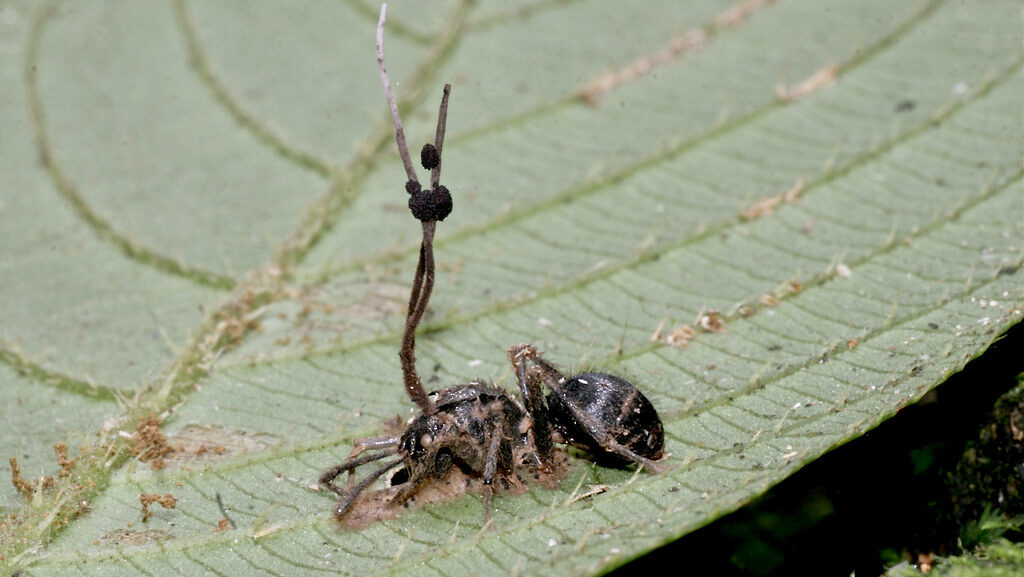
Ophiocordyceps unilateralis and its related species belong to a specialized group of entomopathogenic fungi – organisms that infect and kill insects. These remarkable fungi have evolved highly specific relationships with their ant hosts, often targeting just one or a few closely related species rather than attacking insects indiscriminately. Scientists have discovered over 35 different species in the Ophiocordyceps genus that specialize in manipulating ants, each adapted to particular host species and geographic regions. The relationship between these fungi and their ant hosts likely evolved over millions of years, resulting in astonishingly precise mechanisms for control and reproduction. Their lifecycle represents one of the most dramatic examples of extended phenotype in nature, where the genes of one organism (the fungus) express themselves through the altered behavior of another organism (the ant).
The Infection Process: How Ants Become Zombies

_Figure_6.jpeg)
The zombie ant saga begins when a foraging ant encounters fungal spores in the forest environment, typically on the forest floor. These microscopic spores attach to the ant’s exoskeleton and, through enzymatic action, penetrate the hard cuticle to access the insect’s body cavity. Once inside, the fungus begins a complex process of growth, spreading through the ant’s tissues while carefully avoiding vital organs that would kill the host prematurely if damaged. During the initial infection stage, which can last several days, the ant continues its normal behavior, completely unaware of the fungal invader multiplying within its body. The fungus gradually extends thread-like hyphae throughout the ant’s body, including into the head capsule where it will eventually interface with the nervous system. This stealthy invasion represents a masterful evolutionary strategy that allows the fungus to develop sufficiently before initiating the mind-control phase of its lifecycle.
Mind Control Mechanisms: The Neurobiology of Manipulation

The precise mechanisms by which Ophiocordyceps controls ant behavior have fascinated scientists for decades and continue to be unraveled through cutting-edge research. Rather than directly invading the brain as once thought, studies have revealed that the fungus forms a complex network throughout the ant’s head capsule, surrounding the brain with fungal cells and effectively creating a “fungal brain” that interfaces with the host’s nervous system. The fungus appears to produce compounds that act as neurotransmitters or neuromodulators, chemically hijacking the ant’s behavior circuits without physically destroying brain tissue. Research has identified that the fungus affects specific muscle fibers in the mandibles, causing the characteristic “death grip” where infected ants clamp onto vegetation with their jaws. Gene expression studies have shown that the fungus activates specific genes during the manipulation phase, producing compounds that can alter dopamine levels and other signaling pathways in the ant’s nervous system. This sophisticated biochemical manipulation represents one of the most precise examples of behavior control in the natural world.
The Death Grip: Final Hours of the Zombie Ant

Perhaps the most visually striking and behaviorally specific aspect of the zombie ant phenomenon is the “death grip” – the final action of the infected ant before death. As the fungus takes complete control, it forces the ant to climb vegetation, typically a leaf or small twig, and position itself at a specific height above the forest floor where temperature and humidity conditions are optimal for fungal growth. With remarkable precision, infected ants often bite onto the underside of a leaf or stem along the main vein, securing themselves in position. Once properly situated, the ant experiences a final, powerful mandibular contraction, clamping its jaws onto the plant tissue with such force that the mandibles penetrate the plant material, permanently anchoring the ant in place. This death grip is often accompanied by convulsions as the ant’s muscles lock into their final position. Timing studies have revealed that these climbing behaviors and the death grip often occur around solar noon, suggesting the fungus may be sensitive to light cycles or daily environmental fluctuations that maximize its reproductive success.
Fungal Fruiting: The Spectacular Final Stage

After the ant dies locked in its death grip, the fungus begins its final and most visually dramatic phase – the growth of the reproductive structure. A stalk-like fungal growth called a stroma erupts from the back of the ant’s head, growing perpendicular to the surface the ant is gripping. This stalk can reach several centimeters in length, essentially transforming the ant’s corpse into a fungal launching platform positioned perfectly above the forest floor. The tip of this stalk develops into a capsule filled with spores that, when mature, will be released to infect new ant victims passing below. The positioning of the ant is crucial for this stage – too high, and the spores might not reach new hosts; too low, and they might not disperse effectively. Electron microscope studies have revealed the incredible complexity of these fungal structures, with specialized cells and tissues dedicated to spore production, maturation, and dispersal. The entire process represents an evolutionary marvel where the ant’s body has essentially been converted into an optimally positioned fungal reproductive factory.
Ecological Impact: The Role of Zombie Ants in Forest Ecosystems


Zombie ants play a significant role in tropical forest ecosystems despite their relatively small size and specific niche. By regulating ant populations, these fungi help maintain the delicate balance of species in these biodiverse environments. Studies have estimated that in some forests, up to 20-30% of carpenter ant mortality may be attributed to Ophiocordyceps infections, representing a substantial ecological pressure on these abundant insects. The spatial distribution of infected ants creates what scientists call “graveyards” – areas with higher concentrations of zombie ants that can persist for years, creating zones of elevated spore presence and infection risk. These infection zones influence ant foraging patterns, as colonies may avoid areas with high concentrations of fungal spores, thereby affecting nutrient cycling and plant-ant interactions throughout the forest. Additionally, the nutrients from ant corpses provide resources for other organisms in the ecosystem, creating micro-habitats that support various microbial communities and small invertebrates that feed on fungal tissues.
Geographic Distribution: Where Zombie Ants Thrive

Zombie ant fungi have been documented across tropical and subtropical regions worldwide, with particular diversity in rainforest ecosystems. The Brazilian Amazon represents one of the most studied regions, where pioneering research by scientist David Hughes and colleagues identified numerous species of Ophiocordyceps with distinct host preferences and manipulation strategies. Different species and variants have been discovered in tropical forests across Southeast Asia, particularly in Thailand and Malaysia, where they infect different ant genera with slightly modified manipulation tactics. The forests of Central and South America harbor diverse zombie ant fungi, with researchers continuing to discover new species and host relationships throughout the Neotropics. Even in the United States, particularly in southeastern states with warmer climates like Florida and Louisiana, researchers have documented zombie ant fungi affecting native ant species, though these temperate varieties often show less dramatic manipulation behaviors than their tropical counterparts. The global distribution of these fungi highlights their evolutionary success and adaptability to different host species and environmental conditions.
Evolutionary Arms Race: How Ants Fight Back


The relationship between Ophiocordyceps fungi and their ant hosts represents a classic evolutionary arms race, with each side developing adaptations and counter-adaptations. Ant colonies have evolved various defenses against fungal infection, including sophisticated social immunity behaviors where healthy workers identify and remove infected nestmates before they can spread spores within the nest. Chemical detection systems allow ants to recognize the subtle changes in cuticular hydrocarbons on the exoskeleton of infected individuals, triggering avoidance or aggressive responses. Some ant species have developed foraging patterns that minimize exposure to areas with high concentrations of fungal spores, essentially creating spatial avoidance strategies that reduce infection rates. Physiological defenses include enhanced immune responses that can sometimes overcome early-stage fungal infections before they establish full control. The fungi, in turn, continue to evolve more sophisticated invasion tactics, chemical mimicry to avoid detection, and faster acting control mechanisms to overcome host defenses, creating an ongoing evolutionary battle that has likely been raging for millions of years.
Scientific Discoveries: The History of Zombie Ant Research

The scientific understanding of zombie ants has evolved significantly since their first documentation in the scientific literature. The phenomenon was initially described by British naturalist Alfred Russel Wallace in 1859, who observed ants with strange growths but didn’t understand the parasitic relationship at work. In 1931, British mycologist Tom Petch provided more detailed descriptions of the fungus, then classified as Cordyceps unilateralis, noting its unusual relationship with carpenter ants. The modern era of zombie ant research began in the early 2000s when entomologist David Hughes began systematic studies that revolutionized our understanding of the manipulation mechanisms and species diversity. Technological advances in the 2010s, including micro-CT scanning, transcriptomics, and advanced microscopy, allowed researchers to visualize the fungal networks inside ant bodies and identify the genes and compounds involved in behavioral manipulation. Recent collaborative research has combined field ecology, molecular biology, and computational modeling to create a more comprehensive picture of how these fungi operate, representing a truly interdisciplinary approach to understanding one of nature’s most bizarre parasitic relationships.
Medicinal Potential: From Forest Floor to Pharmacy

The chemical compounds produced by Ophiocordyceps fungi have attracted significant attention for their potential medicinal applications. Related fungal species like Ophiocordyceps sinensis (formerly Cordyceps sinensis) have been used in traditional Chinese medicine for centuries to treat fatigue, kidney disease, and low libido, suggesting bioactive compounds with pharmacological potential. Modern research has identified several compounds from various Ophiocordyceps species with promising antimicrobial, anti-inflammatory, and immunomodulatory properties that could lead to new drug developments. The unique ability of these fungi to produce neuroactive compounds capable of manipulating insect behavior has sparked interest in neuropharmacology research, potentially offering insights into treating human neurological disorders. Some pharmaceutical companies have begun investigating the chemical pathways these fungi use to suppress host immune responses, which might inform new approaches to treating autoimmune conditions or improving outcomes for organ transplantation. The challenge for researchers lies in identifying, isolating, and synthesizing these compounds in ways that can be clinically tested and eventually developed into viable medical treatments.
Cultural Impact: Zombie Ants in Popular Imagination

The disturbing yet fascinating life cycle of zombie ants has captured the public imagination and permeated popular culture in numerous ways. The concept has inspired science fiction writers and filmmakers, who have extrapolated the real-world fungal mind control to imagined scenarios involving human hosts, most notably in works like the video game “The Last of Us,” which features a fictional Cordyceps mutation that infects humans. Documentary filmmakers have featured zombie ants in major productions, including BBC’s “Planet Earth,” David Attenborough’s nature series, and specialized scientific documentaries that bring the microscopic drama to life for general audiences. The phenomenon regularly appears in science education materials as a compelling example of parasitism and behavioral manipulation, making it a favorite topic for biology teachers trying to engage students with the stranger aspects of natural selection. The zombie ant concept has even influenced discussions about free will and consciousness, as philosophers and neuroscientists ponder the implications of an organism whose behavior can be so completely hijacked by another species, raising questions about the nature of autonomy and control in biological systems.
Climate Change Concerns: The Future of Zombie Ant Ecosystems

As global climate patterns shift, researchers have begun investigating how environmental changes might affect the delicate relationship between Ophiocordyceps fungi and their ant hosts. Laboratory studies have demonstrated that these fungi have relatively narrow temperature and humidity requirements for optimal growth and spore germination, making them potentially vulnerable to climate fluctuations. Rising temperatures in tropical forests may force both ants and fungi to adapt their behaviors or migrate to higher elevations where conditions remain suitable, potentially disrupting established ecological relationships. Changes in rainfall patterns could significantly impact infection rates, as many Ophiocordyceps species require specific moisture levels to successfully infect new hosts and complete their life cycles. Habitat fragmentation and deforestation directly threaten zombie ant ecosystems by reducing suitable habitat and potentially isolating fungal and ant populations, which could lead to local extinctions or evolutionary divergence. Some scientists are using zombie ants as bioindicators for forest health, monitoring their presence and infection rates as early warning signs of ecosystem stress in response to climate change and other anthropogenic pressures.
Research Frontiers: The Future of Zombie Ant Science

The study of zombie ants continues to advance as researchers apply cutting-edge technologies to unravel remaining mysteries. Current genomic research is sequencing the complete genomes of various Ophiocordyceps species to identify the genetic basis for their host-specific manipulation capabilities and uncover the evolutionary history of these remarkable adaptations. Advanced neuroimaging techniques are being applied to visualize in real-time how fungal compounds affect neural circuitry in infected ants, potentially revolutionizing our understanding of the precise control mechanisms at work. Microbiome studies are investigating how the presence of other microorganisms within ants might help or hinder fungal infection, revealing complex interactions between hosts, parasites, and their associated microbial communities. Researchers are also developing new mathematical models to predict how zombie ant systems might respond to environmental changes, combining field data with computational approaches to forecast future scenarios. The integration of traditional mycology with modern molecular techniques, behavioral ecology, and systems biology approaches promises to continue yielding fascinating insights into one of nature’s most extraordinary examples of interspecies manipulation.
Practical Applications: Learning from Nature’s Mind Control

Beyond their intrinsic scientific fascination, zombie ant fungi offer practical lessons and applications in various fields. Biological control researchers are studying these fungi as potential models for developing more targeted pest management strategies that could reduce reliance on chemical pesticides. The precise tissue-targeting capabilities of Ophiocordyceps have inspired biomedical researchers working on drug delivery systems that need to reach specific organs or tissues while avoiding others. Computer scientists studying artificial intelligence and control systems have drawn inspiration from the distributed network approach the fungus uses to manipulate its host, informing new approaches to network design and control algorithms. Material scientists are investigating the adhesive compounds that strengthen the death grip for applications in biodegradable glues and medical adhesives that work in moist environments. The fundamental research into how these fungi manipulate behavior could eventually inform therapeutic approaches for human behavioral disorders or diseases affecting motor control, demonstrating how even the most unusual natural phenomena can yield practical benefits when studied thoroughly.
In conclusion, zombie ants represent one of nature’s most extraordinary examples of parasitic manipulation, where the line between individual organisms blurs as one species commandeers the body of another. From the moment a microscopic spore attaches to an unsuspecting ant to the final eruption of the fungal fruiting body from the insect’s corpse, each stage of this relationship showcases the remarkable precision of natural selection. As research continues to unravel the molecular, behavioral, and ecological aspects of this phenomenon, zombie ants remind us that even the most bizarre biological systems follow comprehensible scientific principles. They challenge our understanding of consciousness and control while offering potential applications in medicine, technology, and pest management. In the complex web of tropical forest ecology, these tiny dramas of manipulation and survival represent both the wonder and ruthlessness of evolution – a process that has crafted relationships so strange that they continue to captivate scientists and the public alike, while remaining firmly rooted in the fundamental principles of biology.