
In the grand theater of nature’s sanitation department, insects play the starring role. These tiny creatures, often overlooked or even reviled, perform crucial ecological services by processing waste materials that humans typically find repulsive. From decomposing carcasses to processing fecal matter, these industrious beings work tirelessly to recycle nutrients and maintain environmental balance. Their remarkable adaptations and specialized behaviors have evolved specifically to handle nature’s messiest situations. Without these tiny custodians, our world would quickly become overwhelmed with organic waste. Let’s explore the fascinating world of nature’s clean-up crew—the unsung heroes that tackle the stuff we’d rather not think about.
Dung Beetles: Nature’s Recycling Champions

_couple_(female_on_the_side)_rolling_a_pill_of_elephant_dung_..._(30973016612).jpg)
Dung beetles represent perhaps the most famous members of nature’s sanitation department, specializing in the processing of animal excrement. These remarkable insects can detect fresh dung from remarkable distances, sometimes flying from over a mile away to claim their malodorous prize. Once they locate a dung pile, they quickly get to work—rolling portions into balls, tunneling beneath it, or dwelling within it depending on their specific type. Some species create perfect spheres of dung that they roll away using their hind legs, navigating by the stars to move in straight lines. Their activities accelerate nutrient cycling, improve soil health, reduce pest habitat, and help disperse seeds found in mammalian dung, making them worth an estimated $380 million annually to the U.S. cattle industry alone.
Burying Beetles: Undertakers of the Insect World


Burying beetles, also known as sexton beetles, specialize in the disposal of small vertebrate carcasses, providing an essential service in forest ecosystems. When a pair discovers a dead mouse, bird, or similar small animal, they work together to bury the entire carcass underground, sometimes moving it several feet from its original location. The beetles remove the fur or feathers and treat the carcass with secretions that slow decomposition and suppress bacterial growth. Female burying beetles show remarkable parental care, creating a “nest” from the carcass and feeding regurgitated carrion to their larvae when they hatch. This entire process not only returns nutrients to the soil but also prevents the spread of disease and reduces the availability of carrion for flies to breed in.
Blow Flies: First Responders to Death


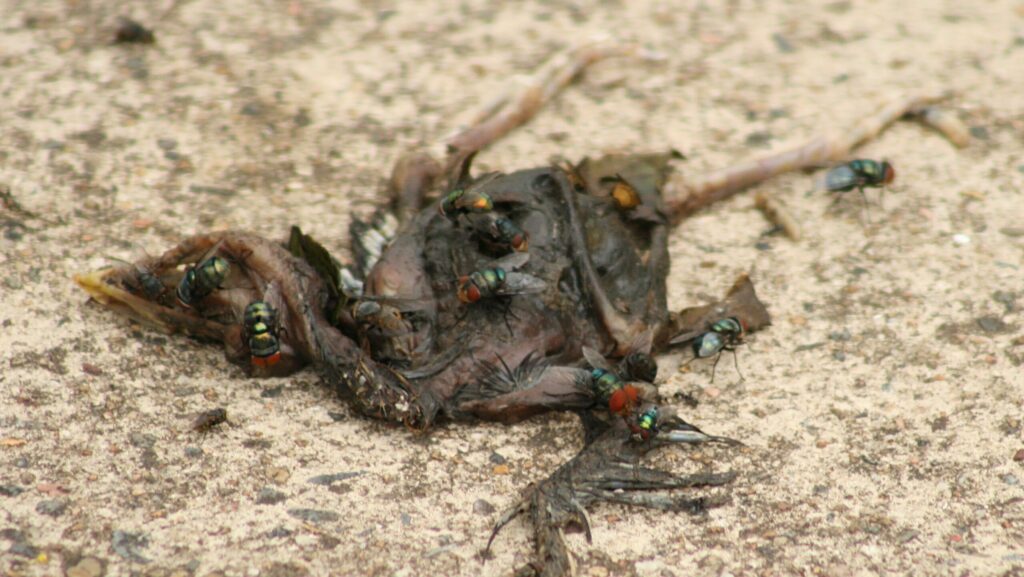
Blow flies may trigger revulsion in many people, but their ecological role is invaluable as among the first insects to detect and colonize dead animals. Equipped with incredibly sensitive olfactory receptors, these metallic-colored flies can detect the gases released by a dead body from miles away, arriving sometimes within minutes of death. Female blow flies lay hundreds of eggs in body openings or wounds, which hatch into voracious maggots that can consume 60% of a carcass in just a few days. Their feeding activity aerates the decomposing tissue, introducing oxygen that helps beneficial bacteria thrive and accelerates decomposition. Beyond their ecological importance, blow flies have become crucial tools in forensic entomology, helping investigators determine time of death in criminal cases.
Dermestid Beetles: Nature’s Skeletal Cleaners


Dermestid beetles, often called “flesh-eating beetles” or “skin beetles,” specialize in consuming dry animal tissues that other decomposers find unpalatable. These remarkable insects can digest keratin, the tough protein found in hair, feathers, and horn, making them nature’s perfect clean-up specialists for the final stages of decomposition. Their larvae are particularly efficient, equipped with specialized mandibles that can scrape away even the tiniest bits of dried tissue from bones. Museums worldwide utilize colonies of dermestid beetles to clean skeletons for scientific collections, as these insects can clean bones more thoroughly and delicately than any chemical process. In natural settings, their work ensures that nutrients contained in these resistant animal tissues eventually return to the ecosystem rather than remaining locked away.
Termites: Wood Waste Specialists


Termites, often maligned as destructive pests, actually perform critical ecological services by breaking down dead wood and plant material that would otherwise accumulate in forests. These remarkable insects can digest cellulose—the main component of plant cell walls—thanks to specialized protozoa and bacteria in their digestive systems that produce the enzyme cellulase. In tropical forests, termites may process up to one-third of all dead wood, transforming tough lignin and cellulose into nutrient-rich soil that supports new plant growth. Their extensive tunneling aerates soil and improves water penetration, while their nitrogen-rich excretions enhance soil fertility. In many ecosystems, particularly in arid regions where decomposition would otherwise be slow, termites represent the primary agents of wood decomposition, accelerating nutrient cycling by orders of magnitude.
Carrion Beetles: Specialized Decomposers

_-_Mississauga,_Ontario_02.jpg)
Carrion beetles comprise a diverse family of insects that have evolved to exploit dead animal matter at various stages of decomposition. Unlike some decomposers that focus on fresh carcasses, many carrion beetles specialize in partially decomposed remains, arriving days after death when the initial decomposition has begun. These beetles possess specialized chemoreceptors that help them locate carcasses at the optimal stage for their feeding preferences. Many species have evolved remarkably with mites that hitch rides on their bodies, jumping off when the beetle reaches a carcass and feeding on fly eggs, thereby reducing competition for the beetle. Some carrion beetles also possess powerful antibiotic secretions that help preserve carcasses from bacterial competition, essentially “managing” their food source to extend its usefulness for their offspring.
Black Soldier Flies: Organic Waste Processors


Black soldier flies have recently gained attention for their extraordinary ability to process nearly any type of organic waste, from food scraps to manure, making them increasingly valuable in sustainable waste management. The larvae of these flies can consume waste twice their body weight daily, reducing the original material volume by up to 95% while converting it into valuable protein and fat within their bodies. Unlike house flies, adult black soldier flies don’t feed at all, lack functional mouthparts, and live only to reproduce, making them non-disease vectors. Their presence actually deters house flies from laying eggs in the same material, further reducing pest potential. These attributes have made black soldier fly farming an emerging industry, with the protein-rich larvae being harvested for animal feed and their frass (excrement) utilized as an excellent organic fertilizer.
Cockroaches: Versatile Garbage Disposals


Despite their reputation as household pests, cockroaches serve as important decomposers in natural ecosystems, breaking down a tremendous variety of organic materials. These hardy insects possess remarkably adaptable digestive systems with diverse gut microbiomes that allow them to process everything from dead plants and animals to paper, glue, and even certain plastics. In forest ecosystems, particularly in tropical regions, cockroaches play a crucial role in leaf litter decomposition, helping to release nutrients back into the soil. Some species specialize in consuming decaying wood, working alongside termites to recycle nutrients from fallen trees. Their ability to survive in nearly any environment and consume almost any organic material makes cockroaches one of nature’s most versatile clean-up specialists, despite their unpopularity among humans.
Ants: The Collective Cleaning Force


Ants operate as one of nature’s most efficient cleaning crews, with colonies working collectively to process enormous amounts of organic waste. Their impact is magnified by their sheer numbers and organization—a single colony may contain millions of individuals that work cooperatively to locate, dismantle, and transport food sources back to their nest. Some ant species specialize in scavenging dead insects and small animals, quickly locating and dismembering carcasses many times their size. Army ants take this role to an extreme, with columns of millions of individuals sweeping through areas and consuming nearly every small organism in their path, including carrion and waste. Leaf-cutter ants process plant material on an industrial scale, bringing cut leaves to their nests where they grow fungus gardens that break down plant cellulose, effectively operating their own composting system.
Flesh Flies: Specialists in Fresh Decomposition

.jpg)
Flesh flies (Sarcophagidae) have evolved a reproductive strategy perfectly suited to their role as decomposers of fresh carrion and excrement. Unlike most flies that lay eggs, female flesh flies are larviparous, meaning they retain their eggs internally until they hatch and then deposit live larvae directly onto the food source. This gives their offspring a critical head start in the race to consume ephemeral resources before they’re claimed by competitors or become unsuitable. Many flesh fly species have developed highly specialized feeding niches, with some targeting only specific types of carrion or waste products. Their larvae possess powerful digestive enzymes that can break down proteins rapidly, allowing them to process fresh tissue before bacterial decomposition advances too far. In natural ecosystems, flesh flies help ensure that nutrients from dead animals quickly return to the food web rather than being locked in slowly decomposing carcasses.
Vulture Bees: Protein-Seeking Pollinators


Among the most unusual members of nature’s clean-up crew are the vulture bees (genus Trigona), a specialized group of stingless bees that have evolved to consume carrion instead of collecting pollen. These remarkable insects possess unique gut bacteria that allow them to safely digest meat, a trait virtually unknown among other bees. When vulture bees locate a dead animal, they use specialized mandibles to harvest small pieces of flesh, which they carry back to their hives and convert into a substance resembling honey. Their digestive enzymes break down the meat proteins and preserve them from bacterial decay, creating a protein-rich food store for their larvae. These unusual bees represent an evolutionary marvel—pollinators that have adapted to exploit a protein-rich food source largely ignored by other bees, demonstrating how even the most specialized ecological niches can be filled.
The Ecological Importance of Nature’s Janitors


The combined activities of these decomposer insects represent one of Earth’s most crucial ecosystem services, without which life as we know it would be impossible. By breaking down dead organisms and waste materials, these insects prevent the accumulation of biological waste and facilitate the recycling of finite nutrients that would otherwise remain locked in dead tissues. Their work helps maintain soil fertility by returning essential elements like nitrogen, phosphorus, and carbon to forms that plants can absorb. Many decomposer insects also serve as important food sources themselves, transferring energy up the food chain to birds, mammals, amphibians, and reptiles. Perhaps most critically, by quickly processing carcasses and excrement, these insects help control populations of pathogenic bacteria and disease-carrying pests that might otherwise proliferate in accumulating waste.
The Unsung Heroes of Our Ecosystems
Nature’s clean-up crew represents the perfect example of how organisms that humans often find unpleasant or disturbing actually provide invaluable ecological services. From the dung beetle rolling its malodorous prize across the savanna to dermestid beetles meticulously cleaning the last fragments of tissue from bones, these insects have evolved specialized adaptations to process materials that would otherwise accumulate and potentially spread disease. Their work ensures that nutrients continue cycling through ecosystems, supporting new life and maintaining environmental balance. As we face growing waste management challenges and seek sustainable solutions, we have much to learn from these efficient decomposers. Perhaps it’s time we developed a greater appreciation for these tiny sanitation workers—the insects that deal with the stuff we’d rather not think about, but upon whose tireless efforts the health of our planet depends.